The Invention of the Ink Chronograph and the Paris Academy of Sciences
The story of the Montblanc Star Legacy Nicolas Rieussec timepiece began on Saturday, September 1, 1821, when Nicolas Rieussec (1781–1866) first tested his timekeeping invention at a horse race. His device recorded the precise times at which all the horses crossed the finish line, literally writing down the time. This gave rise to the term „chronograph.“ Rieussec was not only the sixth watchmaker to the King of France but also a businessman with a keen eye for opportunity. Horse racing was big business in Paris at the time, and the ability to determine winners with scientific precision marked a turning point for the sport.
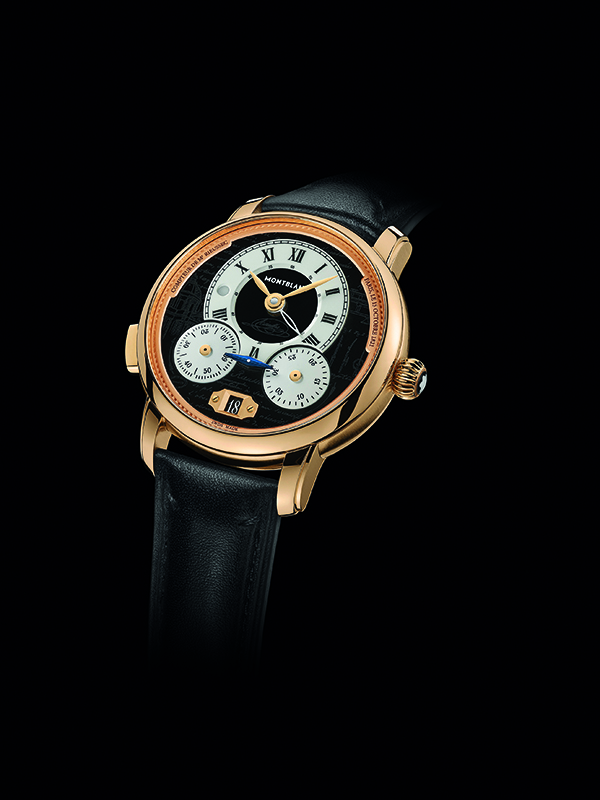
Montblanc presents the Star Legacy Nicolas Rieussec Chronograph Limited Edition 100, crafted from elegant 18K rose gold. This monopusher chronograph—featuring a 24-hour dual-time complication and a date display—draws inspiration from Rieussec’s groundbreaking invention and the city of Paris, where it came to life.
How did Nicolas Rieussec’s device work?
The device developed by Nicolas Rieussec utilized a fixed nib that left a mark on two rotating discs (one for minutes, the other for seconds) each time a horse crossed the finish line. His invention was a resounding success. A few weeks later, he presented it to the French Academy of Sciences in Paris. The members were fascinated and gave the timepiece the new name „chronograph“—a combination of the Greek words *chronos* (time) and *graphein* (to write). With his invention of the first ink chronograph, Nicolas Rieussec secured his place in the history of fine watchmaking. Tracing the Legacy of the Nicolas Rieussec Archive in Paris
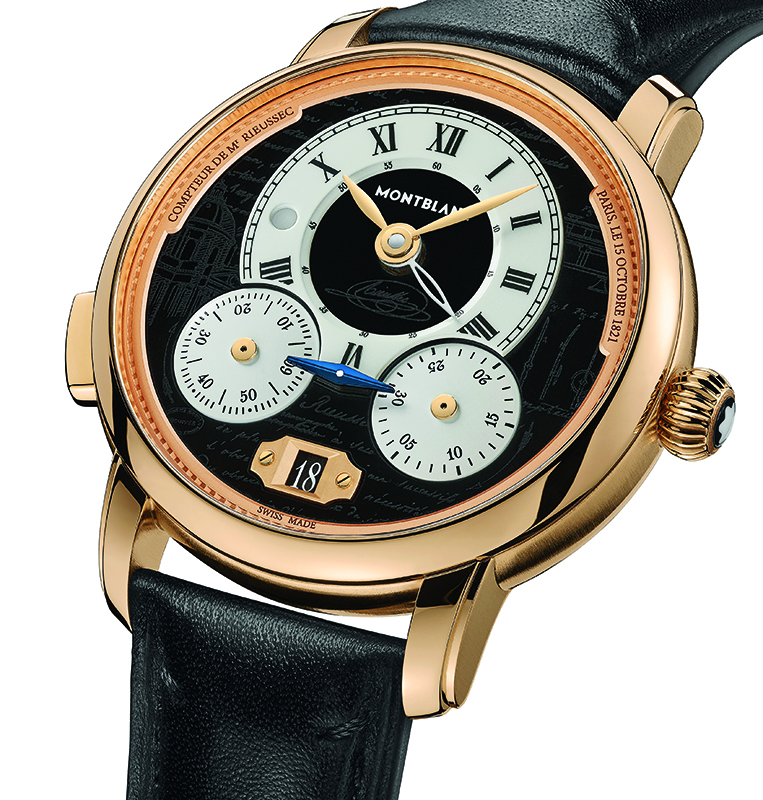
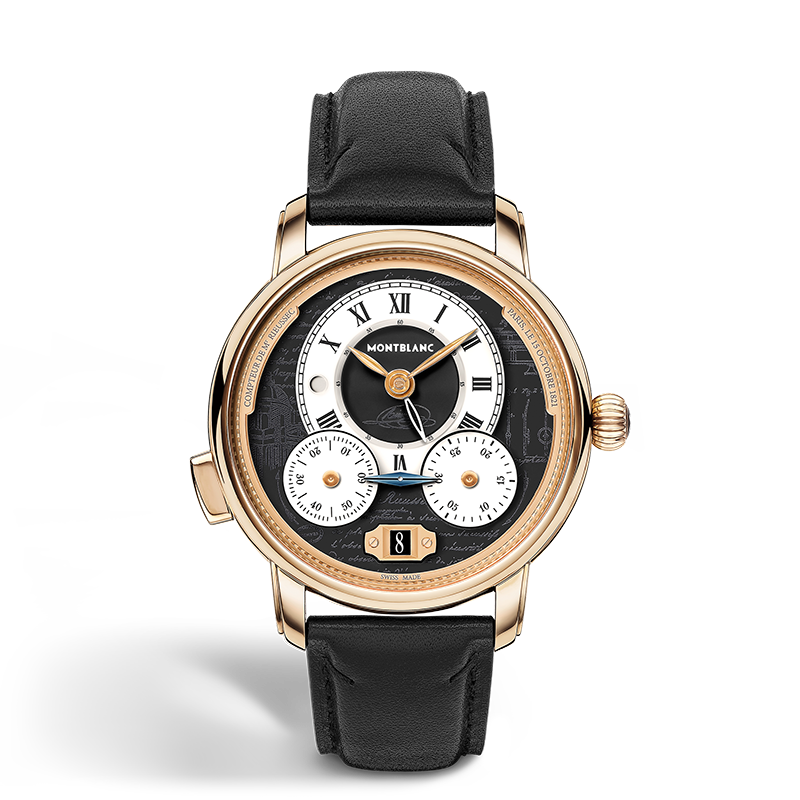
The dial of the Montblanc Star Legacy Nicolas Rieussec Chronograph, adorned with luminous elements, features handwritten excerpts from the patent document, the silhouette of the Academy, a technical drawing of the ink-bearing pointer used in the original „ink chronograph,“ and Rieussec’s signature near the center of the dial. These luminous details also pay tribute to Montblanc’s heritage in the art of writing.
Flanking the rose-gold-colored dial flange (rehaut) are two relief inscriptions: one at 10 o’clock reading „Compteur de Mr Rieussec“—the device’s official name as recorded in the archives—and another at 2 o’clock displaying the date and location of the patent filing: „Paris, le 15 Octobre 1821.“
A complex monopusher chronograph
The Montblanc Star Legacy Nicolas Rieussec Chronograph Limited Edition 100 draws inspiration from Rieussec’s 1821 chronograph. The watch’s two small chronograph dials—a 60-second counter at 8 o’clock and a 30-minute counter at 4 o’clock—feature rotating, domed discs. Positioned between these discs is a horizontal blued-steel bridge that serves as the indicator hand. This configuration faithfully replicates the layout of Rieussec’s original chronograph.
Two time zones are displayed on the off-center main dial, featuring a day/night indicator at 9 o’clock and a skeletonized hour hand; this hand can be adjusted independently of the main hour hand or, when operating in a single time zone, hides elegantly behind it. The rose-gold-coated leaf-shaped hands harmonize perfectly with the gold-colored caps on the small dials and the architectural, applied frame of the date window at 6 o’clock.
A harmonious, in-house developed complication
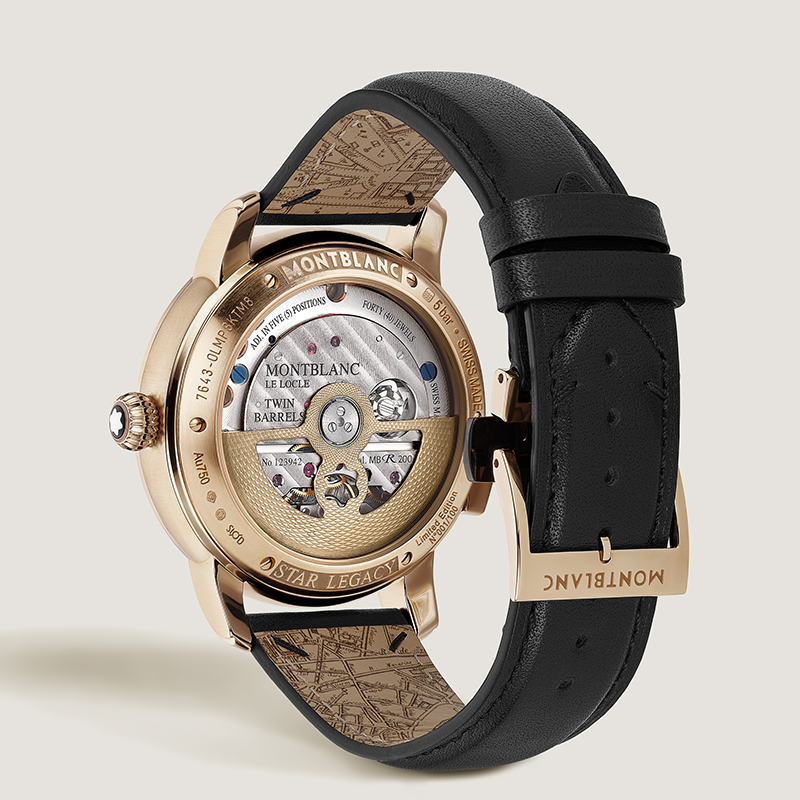
At the heart of the Montblanc Star Legacy Nicolas Rieussec Limited Edition 100 lies the in-house Calibre MB R200. This automatic movement features a monopusher chronograph, a second time zone, and twin barrels providing a 72-hour power reserve—a configuration distinguished by its symmetry and superb craftsmanship.
Visible through the sapphire crystal case back, the MB R200 movement impresses with elegantly curved bridges supporting the gear train and escapement. Each bridge is adorned with visible jewels, large blued screws, and Geneva stripes. The skeletonized self-winding rotor features the Montblanc emblem from 1913 and a *grain d’orge* engraving.
Rose Gold Case
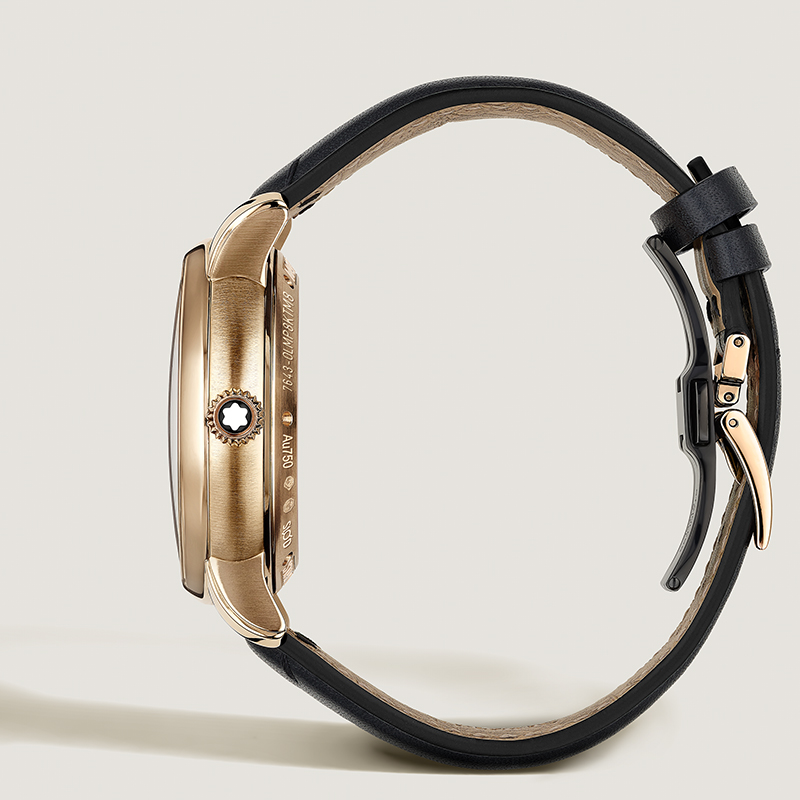
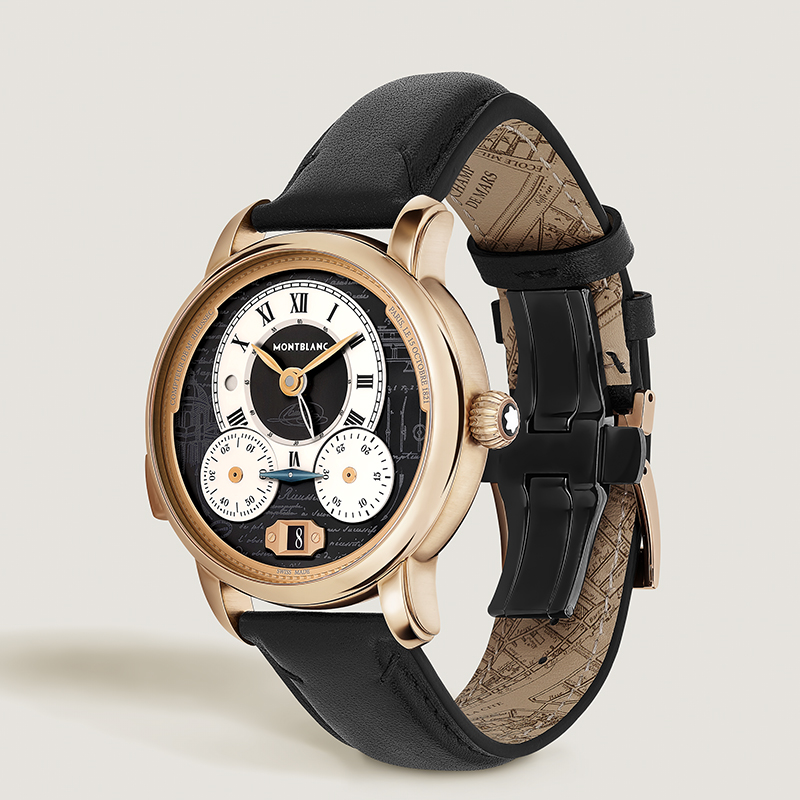
The fully polished 18K rose gold case measures 43 mm in diameter. The curved lugs feature a „stepped“ architecture, while the onion-shaped crown lends the watch a traditional touch reminiscent of the pocket watch era. A fully polished bezel completes the design, placing the intricate dial center stage. The sapphire crystal case back offers a direct view of the Calibre MB R200.
A Strap Honoring Paris and the Invention of the Ink Chronograph
The black calfskin strap, featuring color-coordinated stitching, has a tapered silhouette reminiscent of the shape of a Montblanc nib. This detail is also inspired by the nib used in Rieussec’s „ink chronograph“ of 1821.